June 7- June 13
Women of the Week
Martha H. Mowry, a physician from Providence, Rhode Island, Annie Fillmore Sheardown, a singer and musical educator from Franklin, Connecticut, Jennie Casseday, a philanthropist from Louisville, Kentucky, and Sarah Doan La Fetra, a temperance leader from Sabina, Ohio, are this week's Women of the Week.
-
To learn about them by viewing their items, please click on their images.
-
To read their biographical sketches in A Woman of the Century, please click on the highlighted page numbers to the left of their images.
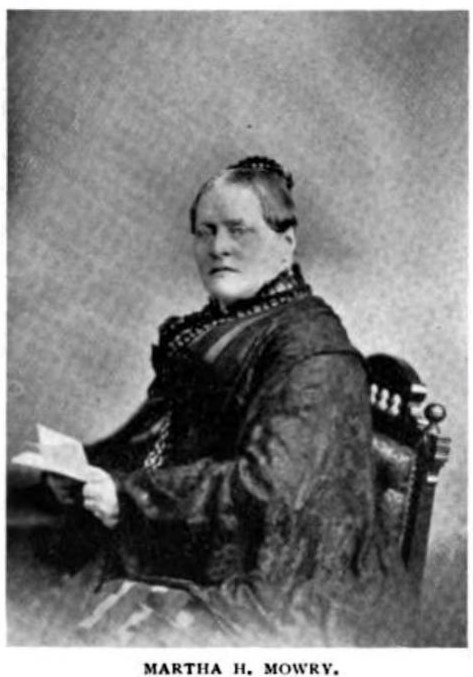
Physician, professor, and lecturer Martha H. Mowry hailed from Providence, Rhode Island. Martha lost her mother when she was an infant, and she was devoted to her father throughout her life. She attended a variety of schools, including the Green Street Select School, where she was taught by Margaret Fuller. Martha took an interest in the areas of anatomy and physiology and began discussing medicine with several medical professionals and lecturing on various medical topics. After working with a variety of physicians in Providence and Boston, and impressing physicians from the Female Medical College of Pennsylvania with her competency, Martha received a medical degree from this new institution. She was recruited to become Professor of obstetrics and diseases of women and children there. When her father requested that she return to Providence, Martha agreed and gave up her teaching career. For almost forty years, Martha had a very successful career as a Providence physician.
The History of Providence County, published in 1891 when Martha was in her early seventies, provided a lengthy biographical sketch of Martha which ended by noting: "She is still doing all the professional work it is well for one of her age to do, and is especially interested in educating mothers to a knowledge of the laws of life, physical, mental, and spiritual" (114).
In addition to her work as a physician, Dr. Mowry was a member of the Providence Physiological Society and the Association for the Advancement of Women.
In addition to Margaret Fuller, Martha's vast personal network included Edna Dow Cheney, Lydia Maria Child, Julia Ward Howe, and Lucretia Mott.
Dr. Mowry passed away on August 29, 1899 and was buried in the Mowry Lot in Smithfield, Rhode Island.
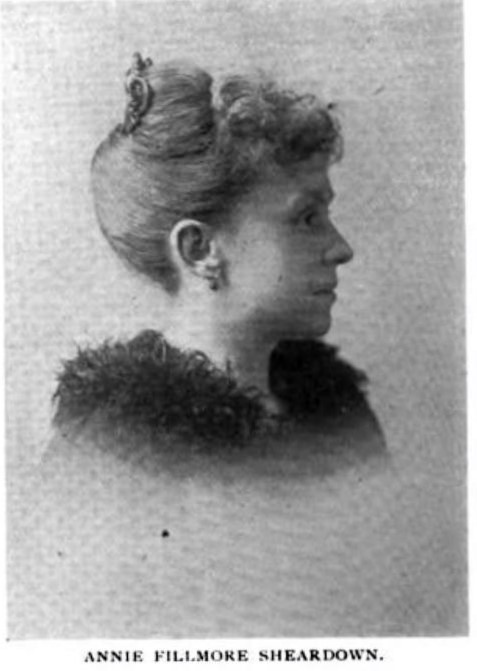
Annie Fillmore Sheardown, daughter of John and Olma J. Burdick, was born in Franklin, Connecticut on June 8, 1856, and spent her youth living in Franklin and Norwich, Connecticut. Passionate about music, she began lessons at a very early age. Over the course of her life, Annie studied with several teachers, including C. R. Hayden, Emma Seiler, and George Sweet. By 1880, she was teaching music. Annie was married to Thomas W. Sheardown for five years during the 1880s, but the couple separated.
Annie's April 1892 essay in Werner's Voice Magazine, "The Philosophy of the Voice in Singing," presented several of her ideas about scientific voice study. In addition, she contributed "The Voice of The Future " to Volume V (November 1893 - April 1894) of Music: A Monthly Magazine, Devoted to the Art, Science, Technic and Literature of Music. In this essay, Annie advocated for her ideas about studying voice, noting, "There is no royal road to learning, but good intelligent study may accomplish wonders" (162). She also praised her mentor, Emma Seiler.
By 1900, Annie was living with her father at 400 Franklin Street in Norwich, Connecticut and teaching music. She passed away on December 6, 1904, and was buried in Norwich's Yantic Cemetery.
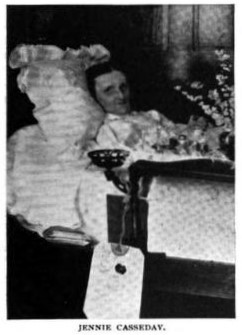
Jennie Casseday, who was born in Louisville, Kentucky on June 9, 1840, was injured as a young woman. As a result, she was bedridden for most of her life. Determined to brighten the lives of others in her situation, she created the Louisville Flower Mission.
During the early years of the Flower Mission, Jennie was contacted by the Harper Brothers, successful New York publishers, to write about her Flower Mission for Harper's Young People. Responding to the publishers, Jennie wrote:
"The mission of flowers has in itsuch possibilities, such deep meanings, so much cheer and brightness for the sick, the aged, the poor, the shut-ins, and for the missionaries themselves, that I find my heart bounding with gladness at the new avenue you have opened for its enlargement"(Duncan, 22).
Word spread about Jennie's mission, and Frances Willard asked Jennie to be the founder of the WCTU's National Flower Mission. Her National and Annual Flower Mission Day, an event on her birthday which resulted in flowers in the cells of prisoners throughout the country, continued even after Jennie's death on February 8, 1893.
In addition, Jennie organized the Shut-In Band, a community of people who, like her, were invalids, and provided a way for them to communicate through the periodical Open Window.
She also supported the Louisville Training School for Nurses and the Rest Cottage "for tired girls and women who have to support themselves" (161), and established a Louisville chapter of the Order of King's Daughters (Duncan, 43).
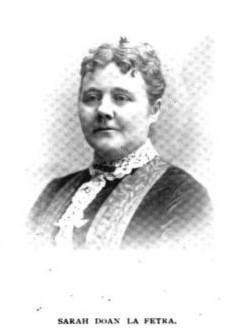
Sarah Doan La Fetra was born in Sabina, Ohio, on June 11, 1843. After attending Alfred Holbrook's National Normal School in Ledyard, Ohio. Sarah was a teacher until her marriage to George H. La Fetra on October 6, 1867.
The La Fetra family moved to Washington, D.C., where they became members of the Metropolitan Methodist Episcopal Church, and Sarah became very active in both mission and temperance activities. She was an early member of the Woman's Christian Temperance Union of Washington, D.C., serving as its treasurer in 1881 and as its president by 1885. According to A Woman of the Century, Sarah was manager of "a temperance hotel and cafe in the very heart of the city of Washington for many years" (443). The Washington Times notes that this was Temple Cafe on F. Street, and she later managed the Hotel Fredonia on I Street. In 1894, Sarah opened Hotel La Fetra on Eleventh and G Street (Streets of Washington). Sarah was still president on February 19, 1895, when she was asked to join Frances Willard and other world and national leaders of the W.C.T.U. in presenting a polyglot petition for prohibiting "drink traffic and the opium trade" to President Cleveland at the White House (Washington Herald, November 15, 1914). In October of that year, she was named Superintendent of the new "Department of Christian Citizenship" at the World W.C.T.U.'s meeting in London. In the Ocala Evening Star of October 30, 1895, Sarah gave a detailed definition of the "Christian citizenship" she wished to promote.
Also very active in missionary work, by the first decade of the twentieth century, Sarah was a leader in the Woman's Interdenominational Mission Union. On April 4, 1912, the Baltimore branch of the Woman's Foreign Missionary Association announced plans to build the Sarah Doane La Fetra Home in Bidar, India. This mission home was named to honor Sarah, the organization's vice president (Washington Herald, April 4, 1912).
The Evening Star included a lengthy article about Mr. and Mrs. La Fetra's fiftieth wedding anniversary party, which was held on October 6, 1917. In addition to mentioning Sarah's leadership in the W.C.T.U., it noted that she "was also an originator of the work for fallen women in Washington, and has for many years been an active worker for the Hope and Help Mission, which was started by the W.C.T.U." According to the article, among those praising Sarah's work was Rosetta Lawson, "organizer of the national W.C.T.U. for colored people."
Sarah passed away on May 7, 1919. In addition to being remembered at her funeral, the W.C.T.U. honored Sarah at a memorial service. While she was no longer living, Sarah was not forgotten. According to the Evening Star of November 30, 1922, Sarah was nominated to be one of "twenty-five great women who have achieved for this community before their deaths" whose names were to be on a column of the new Temple of Womanhood building of the Women's Universal Alliance.