May 17 - May 23
Women of the Week
Rosa Miller Avery, who was a reformer, and Louisa Morton Greene, who was a reformer and author, celebrated birthdays during this week.
-
To learn about them by viewing their item records, please click on their images.
-
To read their biographical sketches in A Woman of the Century, please click on the highlighted page numbers to the left of their images.
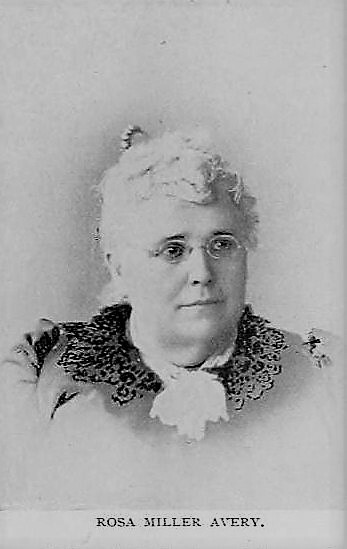
Rosa Miller Avery was born in Madison, Ohio, on May 21, 1830. She married Cyrus Avery in 1853 and became the mother of Cyrus Miller Avery. Her family lived in Ashtabula, Ohio, Erie, Pennsylvania, and then Chicago, Illinois.
A passionate reformer, Rosa worked for Anti-Slavery, Prison Reform, and Women's Rights. On February 11, 1860, Rosa hosted the first meeting of the Ashtabula Ladies' Anti-Slavery Society and became its secretary and treasurer. She wrote an article about the Society's first Annual Meeting at Templars' Hall and the activities of its first year for the Ashtabula Weekly Telegraph. To bring attention to the cause during the Civil War, Rosa wrote articles under a male pseudonym. Later, she wrote in support of women's rights in the Chicago Inter-Ocean. Rosa was a member of the National Council of Women of the United States and the National American Woman Suffrage Association.
Rachel Foster Avery, a woman's rights advocate, was Rosa's daughter-in-law. Rosa's vast social network included Lydia Maria Child, James A. Garfield, and James Redpath.
Devoted to women's rights, Rosa even paid for her newborn granddaughter, Julia Foster Avery, to become a member of the National American Woman Suffrage Association. She passed away at "Rose Cottage," her home in Edgewater, Illinois, on November 9, 1894, and was buried in Middle Ridge Cemetery in Madison, Ohio. In March of 1895, Rosa and several other recently deceased members were honored at the annual meeting of the National Council of Women of the United States.
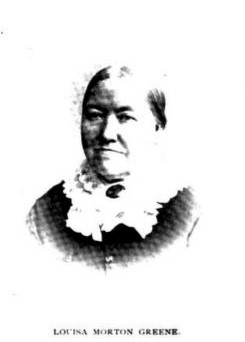
Louisa Morton Willard Greene was born in Ashburnham, Massachusetts, on May 23, 1819. She worked in a woolen mill in Dedham, Massachusetts, where she began writing, and later taught in Portsmouth, New Hampshire.
After marrying businessman and politician Jonas Greene in 1841, Louisa became the mother of a son, Jonas Willard Greene, who was stillborn, two younger sons, Willard Jonas Greene and George Henry Greene, and five daughters, Martha, Estelle, Christina, Wilma, and Charlena. The family lived in Peru, Maine.
Louisa was involved in many philanthropic and reform activities, including ministering to the sick using the Water Cure, and participating in philanthropy, anti-slavery reform, temperance reform, and suffrage efforts. She utilized her public speaking and journalistic talents on behalf of the causes she believed in.
Before the Civil War, Louisa wrote poetry, contributed articles to the Oxford Democrat, and led anti-slavery efforts in her area As her daughter Christina later remembered, Louisa was very active in the war effort: "During the civil war Mrs. Greene's patriotic labors were untiring. In addition to multitudinous home duties, which were always faithfully performed, she took upon herself the labor of collecting, preparing and forwarding hospital supplies for the boys at the front who were so dear to her heart."
In 1869, Louisa's family moved to Manassas, Virginia, residing at the home they named Birmingham. She became a widow four years later.
Louisa passed away in Washington, D.C. on March 5, 1900, and her ashes were buried in the family plot at St. Paul's Cemetery in Alexandria, Virginia. In addition to Christina's beautiful obituary, her daughter Estelle penned a farewell announcement and included a poem that she had written about her mother's passing. Within her tribute, Estelle included Louisa's motto: "Help for the living and hope for the dead."
At the National American Woman Suffrage Association Convention in February of 1902, it was announced that Louisa had bequeathed one humdred dollars to the organization.